

-
1 insulating components
insulating components Isolierbauteile nplEnglish-German dictionary of Electrical Engineering and Electronics > insulating components
-
2 пластмассовая трубная арматура
изоляционная трубная арматура
-
[IEV number 442-02-23]EN
insulating conduit fitting
conduit fitting which consists of insulating material, and which has no conductive components
[IEV number 442-02-23]FR
accessoire isolant de conduit
accessoire de conduit en matériau isolant ne comportant pas de composants conducteurs
[IEV number 442-02-23]Тематики
- электропроводка, электромонтаж
EN
DE
FR
Русско-немецкий словарь нормативно-технической терминологии > пластмассовая трубная арматура
-
3 пластмассовые трубы для электропроводок
пластмассовые трубы для электропроводок
-
изоляционная труба1)
-
[IEV number 442-02-11]EN
insulating conduit
a conduit which consists uniquely of insulating material and which has no conductive components whatever, either in the form of an internal lining, or in the form of external metal braid or coating
[IEV number 442-02-11]FR
conduit isolant
conduit réalisé exclusivement en matériau isolant sans aucun élément conducteur, que ce soit sous forme de revêtement interne ou de tresse ou de revêtement métallique externe
[IEV number 442-02-11]1) В российской документации применяют термин пластмассовая труба
[Интент]
2.5. Следует применять пластмассовые трубы, т.к. они не требуют защиты от коррозии, обладают малым весом, гладкой поверхностью и высокими электроизоляционными свойствами, технологичны при монтаже.
Стальные трубы следует применять в тех случаях, когда механическая и термическая прочность пластмассовых труб недостаточна, а также исходя из условий обеспечения взрыво-пожаробезопасности установок и экономической целесообразности.
3.2. Пластмассовые трубы для электропроводок изготавливают из полиэтилена (ПЭ) высокого давления (ПВД), полиэтилена низкого давления (ПНД), непластифицированного поливинилхлорида (НПВХ) и полипропилена (ПП).
3.3. Трубы изготавливают гладкими и гофрированными. Гофрированные трубы по сравнению с гладкими имеют в два раза меньшую материалоемкость.
Температура начала размягчения для труб из НПВХ – 60 °С, ПВД – 90 °С, ПНД – 100 °С, ПП – 120 °С.
3.4. По результатам испытаний на горючесть трубы из полиэтилена и полипропилена являются горючими, трубы из поливинилхлорида (непластифицированного) - трудногорючими.
3.5. Гладкие трубы из ПЭ с наружным диаметром до 50 мм и из ПП - до 32 мм поставляются в бухтах. При большем наружном диаметре трубы поставляются прямолинейными отрезками длиной 5-10 м в пачках. Гладкие трубы из НПВХ поставляют в пачках прямолинейными отрезками длиной 6-10 м с раструбом на одном конце или без раструба. Гофрированные трубы поставляются в бухтах.
3.6. Пластмассовые трубы обладают различной степенью стойкости к химически активным и др. средам и их выбор следует производить, руководствуясь данными каталога «Химическая стойкость труб из термопластов» (г. Черкассы, НИИТЭХИМ, 1985 г.), а также краткими данными химической стойкости пластмассовых труб, приведенными в справочном прил.1.
4.4. Для соединения и присоединения пластмассовых труб следует применять соединительные муфты и уплотнительные втулки по ТУ 36-1728-81, мерные отрезки шланга из термоусаживающегося материала.
[Министерство архитектуры, строительства и жилищно-коммунального хозяйства. Концерн «ЭЛЕКТРОМОНТАЖ». Инструкция по монтажу электропроводок в трубах]Недопустимые, нерекомендуемые
Тематики
- электропроводка, электромонтаж
EN
DE
FR
Русско-немецкий словарь нормативно-технической терминологии > пластмассовые трубы для электропроводок
-
4 длительный допустимый ток
- Strombelastbarkeit, f
- Dauerstrombelastbarkeit, f
(длительный) допустимый ток
Максимальное значение электрического тока, который может протекать длительно по проводнику, устройству или аппарату при определенных условиях без превышения определенного значения их температуры в установившемся режиме
[ ГОСТ Р МЭК 60050-826-2009]
Этот ток обозначают IZ
[ ГОСТ Р 50571. 1-2009 ( МЭК 60364-1: 2005)]EN
(continuous) current-carrying capacity
ampacity (US)
maximum value of electric current which can be carried continuously by a conductor, a device or an apparatus, under specified conditions without its steady-state temperature exceeding a specified value
[IEV number 826-11-13]
ampacity
The current in amperes that a conductor can carry continuously under the conditions of use without exceeding its temperature rating.
[National Electrical Cod]FR
courant (permanent) admissible, m
valeur maximale du courant électrique qui peut parcourir en permanence, un conducteur, un dispositif ou un appareil, sans que sa température de régime permanent, dans des conditions données, soit supérieure à la valeur spécifiée
[IEV number 826-11-13]Ampacity, the term is defined as the maximum amount of current a cable can carry before sustaining immediate or progressive deterioration. Also described as current rating or current-carrying capacity, is the RMS electric current which a device can continuously carry while remaining within its temperature rating. The ampacity of a cable depends on:
- its insulation temperature rating;
- conductor electrical properties for current;
- frequency, in the case of alternating currents;
- ability to dissipate heat, which depends on cable geometry and its surroundings;
- ambient temperature.
Electric wires have some resistance, and electric current flowing through them causes voltage drop and power dissipation, which heats the cable. Copper or aluminum can conduct a large amount of current before melting, but long before the conductors melt, their insulation would be damaged by the heat.
The ampacity for a power cable is thus based on physical and electrical properties of the material & construction of the conductor and of its insulation, ambient temperature, and environmental conditions adjacent to the cable. Having a large overall surface area may dissipate heat well if the environment can absorb the heat.
In a long run of cable, different conditions govern, and installation regulations normally specify that the most severe condition along the run governs the cable's rating. Cables run in wet or oily locations may carry a lower temperature rating than in a dry installation. Derating is necessary for multiple circuits in close proximity. When multiple cables are near, each contributes heat to the others and diminishes the amount of cooling air that can flow past the individual cables. The overall ampacity of the insulated conductors in a bundle of more than 3 must be derated, whether in a raceway or cable. Usually the de-rating factor is tabulated in a nation's wiring regulations.
Depending on the type of insulating material, common maximum allowable temperatures at the surface of the conductor are 60, 75 and 90 degrees Celsius, often with an ambient air temperature of 30°C. In the U.S., 105°C is allowed with ambient of 40°C, for larger power cables, especially those operating at more than 2 kV. Likewise, specific insulations are rated 150, 200 or 250°C.
The allowed current in cables generally needs to be decreased (derated) when the cable is covered with fireproofing material.
For example, the United States National Electric Code, Table 310-16, specifies that up to three 8 AWG copper wires having a common insulating material (THWN) in a raceway, cable, or direct burial has an ampacity of 50 A when the ambient air is 30°C, the conductor surface temperature allowed to be 75°C. A single insulated conductor in air has 70 A rating.
Ampacity rating is normally for continuous current, and short periods of overcurrent occur without harm in most cabling systems. The acceptable magnitude and duration of overcurrent is a more complex topic than ampacity.
When designing an electrical system, one will normally need to know the current rating for the following:- Wires
- Printed Circuit Board traces, where included
- Fuses
- Circuit breakers
- All or nearly all components used
Some devices are limited by power rating, and when this power rating occurs below their current limit, it is not necessary to know the current limit to design a system. A common example of this is lightbulb holders.
[http://en.wikipedia.org/wiki/Ampacity]
Тематики
- электротехника, основные понятия
Синонимы
EN
DE
- Dauerstrombelastbarkeit, f
- Strombelastbarkeit, f
FR
- courant admissible, m
- courant permanent admissible, m
Русско-немецкий словарь нормативно-технической терминологии > длительный допустимый ток
-
5 изолированный провод
- Ader, f
изолированный провод
—
[Я.Н.Лугинский, М.С.Фези-Жилинская, Ю.С.Кабиров. Англо-русский словарь по электротехнике и электроэнергетике, Москва, 1999 г.]EN
core insulated conductor
assembly comprising a conductor and its own insulation (and screens, if any)
[IEC 61892-4, ed. 1.0 (2007-06)]
core-insulated conductor (North America)
assembly comprising a conductor and its own insulation (and screens, if any)
NOTE In North American usage, the core of a cable has been defined as the assembly of components of a cable lying under a common covering such as the sheath (jacket).
[IEC 60092-350, ed. 3.0 (2008-02)]FR
conducteur (isolé)
ensemble comprenant l'âme, son enveloppe isolante et ses écrans éventuels
Note – En Amérique du Nord le terme “core of a cable” a été défini comme l'ensemble des constituants d'un câble disposés sous un revêtement commun, tel que la gaine. L'utilisation de ce terme est déconseillée dans ce sens.
[ IEV ref 461-04-04]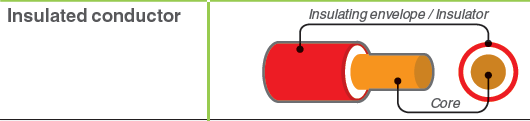
Рис. Schneider Electric
Параллельные тексты EN-RU
An insulated conductor is made up of a conductor core and its
insulating envelope.
[Schneider Electric]Изолированный провод состоит из токопроводящей жилы и изоляции провода.
[Перевод Интент]Тематики
- кабели, провода...
EN
- core insulated conductor
- core-insulated conductor
- covered conductor
- covered wire
- insulated conductor
DE
- Ader, f
FR
Русско-немецкий словарь нормативно-технической терминологии > изолированный провод
См. также в других словарях:
Components of jet engines — Diagram of a typical gas turbine jet engine. Air is compressed by the fan blades as it enters the engine, and it is mixed and burned with fuel in the combustion section. The hot exhaust gases provide forward thrust and turn the turbines which… … Wikipedia
electrical components — ▬▬▬▬▬▬▬▬ Types of electrical components and devices include: adaptor ammeter armature battery bayonet fitting cable ceiling rose circuit breaker conduit continuity tester copper conductor dimmer switch dry cell battery earthed plug electrical… … Useful english dictionary
wax — wax1 waxable, adj. waxlike, adj. /waks/, n. 1. Also called beeswax. a solid, yellowish, nonglycerine substance allied to fats and oils, secreted by bees, plastic when warm and melting at about 145°F, variously employed in making candles, models,… … Universalium
building construction — Techniques and industry involved in the assembly and erection of structures. Early humans built primarily for shelter, using simple methods. Building materials came from the land, and fabrication was dictated by the limits of the materials and… … Universalium
Printed circuit board — Part of a 1983 Sinclair ZX Spectrum computer board; a populated PCB, showing the conductive traces, vias (the through hole paths to the other surface), and some mounted electrical components A printed circuit board, or PCB, is used to… … Wikipedia
wood — wood1 woodless, adj. /wood/, n. 1. the hard, fibrous substance composing most of the stem and branches of a tree or shrub, and lying beneath the bark; the xylem. 2. the trunks or main stems of trees as suitable for architectural and other… … Universalium
Wood — /wood/, n. 1. Grant, 1892 1942, U.S. painter. 2. Leonard, 1860 1927, U.S. military doctor and political administrator. * * * I Hard, fibrous material formed by the accumulation of secondary xylem produced by the vascular cambium. It is the… … Universalium
Resistor — A typical axial lead resistor Type Passive Working principle Electrical resistance Invented Ge … Wikipedia
Insulator (electrical) — Ceramic insulator at railways Conducting copper wire insulate … Wikipedia
Transmission line — This article is about the radio frequency transmission line. For the power transmission line, see electric power transmission. In communications and electronic engineering, a transmission line is a specialized cable designed to carry alternating… … Wikipedia
Coaxial cable — RG 59 flexible coaxial cable composed of: A: outer plastic sheath B: woven copper shield C: inner dielectric insulator D: copper core Coaxial cable, or coax, has an inner conductor surrounded by a flexible, tubular insulating layer, surrounded by … Wikipedia
